Homer Gamache murder
The Dark HalfHomer Gamache murder is the killing of Homer Gamache, an older man who stops for a hitchhiker near his home and does not return. The crime’s meaning emerges in stages: a witness reports a late-night pickup, the missing truck makes the encounter ominous, and Sheriff Alan Pangborn reconstructs how the stranger exploited Homer’s trust and disability before stealing the vehicle.
The roadside encounter
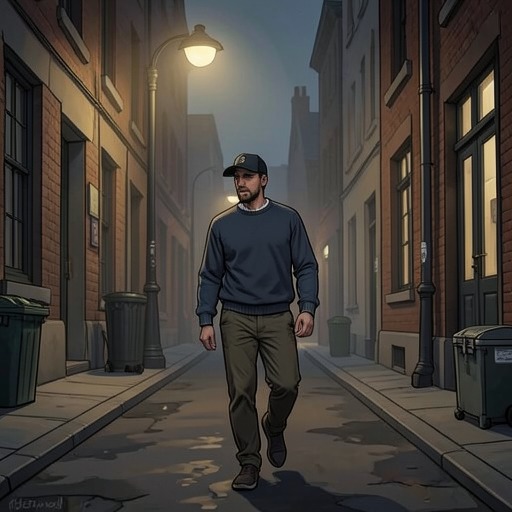
At about a quarter to one in the morning, Mrs. Arsenault saw a man standing by the road and looking toward her lighted window. His direction of travel was uncertain, but when Homer’s truck appeared, the stranger raised his thumb in the familiar gesture of a hitchhiker. Mrs. Arsenault saw Homer stop; the truck’s taillights flashed, and the man ran to the passenger side and climbed into the cab. The moment was brief, but it supplied the last known account of Homer alive.
The circumstances made the pickup unsettling in retrospect. The hitchhiker wore a suit and tie, and the encounter took place in a remote area at an hour when an ordinary traveler would more likely have found shelter for the night. Mrs. Arsenault knew Homer had lived nearby for nearly thirty-five years. She reasoned that he was not simple-minded, so his decision to take a stranger seemed more likely to reflect drink or an impulse to help than poor judgment. The truck had picked up its passenger no more than three miles from Homer’s own dooryard, yet Homer never made it home.
Discovery and reconstruction
Pangborn considered the simplest explanation first: a half-drunk older man had stopped to help a stranger, who attacked him and took his truck. He imagined the hitchhiker using an ordinary pretext to get Homer to pull over, then dragging him from the cab and leaving him in a roadside ditch. The stolen truck, which could be traced through its license plate, and the marks left by Homer’s shoes helped establish the movements Pangborn believed had occurred.
The killing was not simply a fatal blow followed by theft. Once the attacker had pulled Homer from the truck, he discovered that Homer had only one functioning arm and a prosthesis. At the bottom of the ditch, the stranger wrenched the prosthetic arm away and used it to kill him. Pangborn understood that the assailant had recognized Homer’s disability during the attack and made it part of the violence. The investigation would bring the coroner and state-police personnel to the scene, but the physical evidence had already given Pangborn a grim outline of the crime.
The victim and the brutality of the crime
Pangborn’s private anger centers not on an abstract victim but on the life Homer had been leading: an older man, impaired by drink that night, with one sound arm and a bowling league night as one of his remaining pleasures. Pangborn thinks the attacker could have struck him once in the cab and left him alive; he even considers whether Homer might have survived until help came. That imagined alternative makes the murder’s excess impossible to separate from its practical motive. Taking the truck could explain an assault, but it could not explain why Homer had to be killed in this particular way.
Homer’s prosthesis is therefore both a concrete detail of his life and a defining element in Pangborn’s reconstruction. The evidence establishes that the attacker used it as a weapon after discovering Homer’s impairment; it does not establish that Homer’s disability caused the encounter or made him responsible for what followed. Rather, the sequence shows the assailant turning a bodily difference into an opportunity for violence. Pangborn’s response keeps the focus on the person whose life was taken, not merely on the evidence left behind.
Place in the larger case
The murder becomes one of the first links by which the stranger’s movement can be followed. In a later conversation, Thad Beaumont sketches the elaborate alibi the sheriff might have suspected: an identical twin could have remained at a party in Castle Rock while Thad drove Homer’s truck away, abandoned it at a Connecticut rest stop, obtained another car, went to New York City, and traveled onward to Washington, D.C., before returning to Ludlow. Thad’s account is explicitly a hypothetical reconstruction, not an established account of events; its function is to expose how the evidence might implicate him and how far an imagined double could complicate the question of identity.
The killing also connects the case to the hard-boiled crime fiction associated with George Stark. Thad explains that the fictional professional thief Parker, created under the pen name Richard Stark by Donald E. Westlake, pursues a single objective with the relentlessness of a programmed machine; he compares that model to Alexis Machine, the central character in the George Stark novels. The resemblance places Homer’s murder beside a fictional tradition of instrumental, goal-driven violence. But the scene Pangborn reconstructs resists reducing Homer to a prop in that pattern: his ordinary generosity, his neighborhood ties, and his bowling night give the crime a human cost that the criminal’s single-mindedness ignores.